Oct 12, 2026Buyer Guides
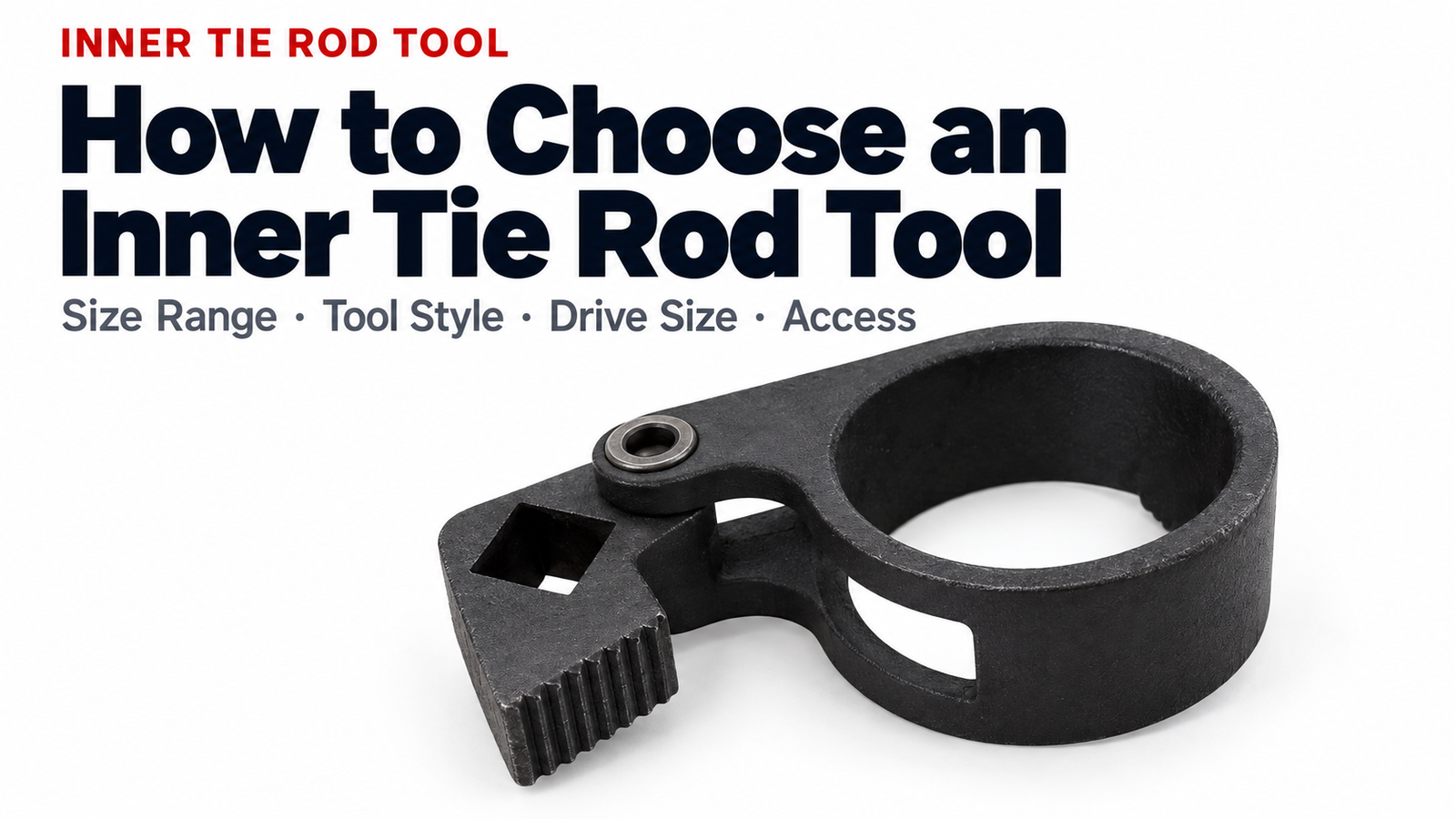
How to Choose an Inner Tie Rod Tool: Size Range, Tool Style, Drive Size & Access
Compare inner tie rod tools by size range, tool style, drive size and access — why “universal” and vehicle brand alone are not fitment specifications.
1. Quick Answer
An inner tie rod tool is selected by the socket it has to grip, not by the word universal or the vehicle brand. Three things decide whether a tool suits the job: the size range it covers, the style of the tool head, and the drive size it takes — plus whether the wrench flats on the tie rod are reachable. "Universal" is a product-type label that still carries a specific grip band; it is not a compatibility guarantee.
2. Why "Universal" Is Not Enough
The word "universal" should not be treated as unlimited vehicle compatibility. Professional tool manufacturers still define working ranges, socket configurations or application conditions for tools marketed as universal. One maker's cam-style wrench covers 33–41 mm hex, two-flat and round rack ends; another covers 38–48 mm; a set-screw style is sold as fitting sockets up to a stated maximum. In every case there is a band and a grip type, and outside it the tool will not turn the socket.
So "universal" tells you the tool is flexible within its range, not that it fits every vehicle. The buying question is what band and what grip type, matched to the rack ends you actually service.
3. Why the Tie-Rod Diameter Range Matters
The size figure on these tools is the dimension across the inner tie rod end socket that the tool must grip — a hex across flats, two flats, or a round ball-head diameter. It is a measurement of the part, not a vehicle label.
That is why the range has to be confirmed against the work, and why it has to be measured the same way the tool is specified. A tool rated for one band does not reach a socket below or above it, even when the vehicle is the same. Confirm the socket dimension and the tool's stated range together.
4. Adjustable Clamp-Style vs Tube-and-Crowfoot Systems
Inner tie rod tools come in two common styles.
An adjustable clamp or cam style wraps the socket with a head that tightens against it — some use three set screws that clamp the rounded socket or its flats, others a cam lever. These are built for round sockets and for sockets whose flats are hard to reach.
A tube-and-crowfoot style slips a long tube over the tie rod end and engages the socket with a crowfoot that locks into a retainer, turning on a square drive. Instruction sheets describe seating the crowfoot on the flats and locking it before turning. This style needs accessible flats or a socket the crowfoot can seat on.
Neither is better in the abstract. The choice follows the socket in front of you and what can be reached.
5. When Wrench-Flat Access Changes the Tool Choice
Access is often the deciding factor. A tube-and-crowfoot tool engages the wrench flats on the socket, so it needs those flats to be reachable. Where the flats are buried or the socket is fully round, a clamp or cam head that grips the outside of the socket is the one that works.
Manufacturer literature makes the split explicit: one crowfoot set is described for tie rods with inaccessible flats, while a clamp-style wrench is described for completely round end sockets. The same job can therefore call for a different tool style purely because of what can be reached.
6. Why Drive Size Must Be Confirmed
The drive is the input the tool exposes to the technician's ratchet, breaker bar or torque wrench. Square-drive tools commonly take a 1/2″ drive, but the drive has to match the tools and extensions the user has — and the access they give.
Drive also interacts with the instructions. Manufacturer sheets specify the drive to turn the tool, and at least one warns against using an impact wrench on its tool. Since guidance on impact use is specific to each maker, treat the drive and any use restriction as part of the tool's documented configuration rather than a given.
7. Why Vehicle Brand Alone Is Not a Fitment Specification
The same vehicle brand spans more than one rack and socket design. Manufacturers pair different crowfoot sizes with different makes and applications, and a single brand can appear against several sizes. Brand names the vehicle; it does not name the socket.
That is why a brand-only description cannot confirm fitment, and why fitment references are usually resolved further — by the socket dimension, the rack type, or the maker's own application list. For a buyer, the reliable approach is to work from the socket the tool must turn, not from the badge on the car.
8. What Distributors Should Ask a Supplier to Document
The size range, and how that size is measured (hex across flats, two flats, or round).
The tool style — adjustable/clamp or tube-and-crowfoot.
The drive size and the input it accepts.
Access requirements: whether the tool needs accessible flats or works on round sockets.
What is included in the set, where it is a set.
Any stated restriction on use, where the maker documents one.
A description that offers only the word universal, or only a vehicle brand, is not yet a specification. These fields are what let two tools be compared on the same basis.
9. TEKO Confirmed Configuration
FJ06-0541, the Multi-Purpose Inner Tie Rod Tool, is documented for inner tie rod service with a capacity of 27–42 mm and a 1/2″ drive. It is made from 45# carbon steel with a phosphating finish and weighs 0.35 kg. It is packed as a box, QTY 60, G.W./N.W. 21.5/21 kg, MEAS 29×26×27 cm, and sits in the Suspension, Steering & Bearing Tools range.
The published material gives the capacity range, drive, material, finish and weight, but does not name the tool style or list a vehicle application table. A buyer with a fitment requirement should send the tie-rod socket size and access conditions they need to cover, so the configuration can be checked against them rather than assumed from the range alone. For different packaging, labeling or branding, send the requirement with your inquiry so it can be reviewed case by case.
10. Frequently Asked Questions
What size inner tie rod tool do I need?
Start from the socket you have to turn — its dimension across flats and whether it is hex, two-flat or round — then check the tool's stated size range covers it. The range is a measurement of the part, not a vehicle label.
Is a "universal" inner tie rod tool enough?
"Universal" means the tool grips several socket configurations within a stated band. It is not a fitment guarantee. Confirm the band and the grip type against the sockets you service.
What is the difference between a clamp-style and a tube-and-crowfoot inner tie rod tool?
A clamp or cam style grips the outside of the socket and suits round sockets or hard-to-reach flats; a tube-and-crowfoot style slips over the tie rod end and engages the wrench flats with a crowfoot that locks in. Access to the flats usually decides between them.
Do I need to confirm the drive size?
Yes. The drive must match the ratchet, breaker bar or torque tool the user has. Square-drive tools commonly take a 1/2″ drive, and any restriction on use should be taken from the maker's own documentation.
Why isn't the vehicle brand enough to confirm fitment?
The same brand spans more than one rack and socket design. Fitment is set by the socket the tool must grip and, where documented, the maker's application reference — not by the badge alone.
What should distributors confirm before ordering an inner tie rod tool?
The size range and how it is measured; the tool style; the drive size; the access requirements; what is included; any stated use restriction; and packaging or private-label options.
11. Request a Configuration Check
Send us the tie-rod size and tool requirements you need to cover, and we will confirm whether the available configuration fits your program.
---