Oct 16, 2026Buyer Guides
How to Choose a Belt Tensioner Wrench Set: Interface, Size Coverage & Access
Compare belt tensioner wrench sets by interface, size coverage and access — why a size fit is not the same as an access fit, and what to confirm before ordering.
1. Quick Answer
A belt tensioner wrench set should not be selected by nominal size alone. Buyers also need to confirm the tensioner interface, the size coverage required, and whether the tool geometry provides enough access to operate the tensioner in the available engine-bay space. A size fit is not the same as an access fit: a tool that carries the right sizes can still fail to reach or turn the tensioner. Confirm the interface, the coverage and the clearance before comparing kits.
2. Why Size Alone Does Not Confirm Tool Fit
A size list tells you which fasteners a set can engage. It does not tell you whether the tool will physically work on the engine in front of you. Two sets can both list a given size yet differ in shape, length and thickness, and those differences decide whether the tool fits the space around the tensioner.
Tool makers treat sizing and access as separate things for this reason. One maker's tensioner tool lists the interfaces it fits, and separately lists a solution for hard-to-access tensioners — the size list and the reach problem are different questions. Read the size list and the access question as two separate checks.
3. Start With the Tensioner Interface
The tensioner interface is the shape the tool must engage, and it is the first thing to identify. Tensioner pulleys do not use one interface: makers describe metric hex sizes, square drives, twelve-point shapes and other profiles, and some tensioners are held or released through a pin or housing detail rather than a hex or square at all.
Because the interfaces differ, a tool has to match the actual interface on the engine, not a nominal size that sounds similar. Confirm what the tensioner presents — a hex or E-profile size, a square drive, a twelve-point, or a pin — and match the tool to that. A set built for one interface may not engage another.
4. Check the Required Size Coverage
Coverage is the list of sizes a set can actually engage, and it is compared as a list, not as a single number. Manufacturers publish coverage as a piece count together with explicit size values or ranges; the piece count alone does not tell you which sizes are included or how many of each.
So the check is: does the set's published size list reach the sizes on your target applications? Compare the E-profile sizes and the twelve-point sizes the set provides against the fasteners you need to turn, and treat any gap as a question to resolve with the supplier rather than assuming the kit covers it.
5. Why Engine-Bay Access Changes the Tool Choice
Access is what separates a tool that fits on paper from one that works in the bay. Where a tensioner sits low or tight, the tool has to reach into the space and be turned within it; a bulky or straight tool can be blocked even when it carries the right size.
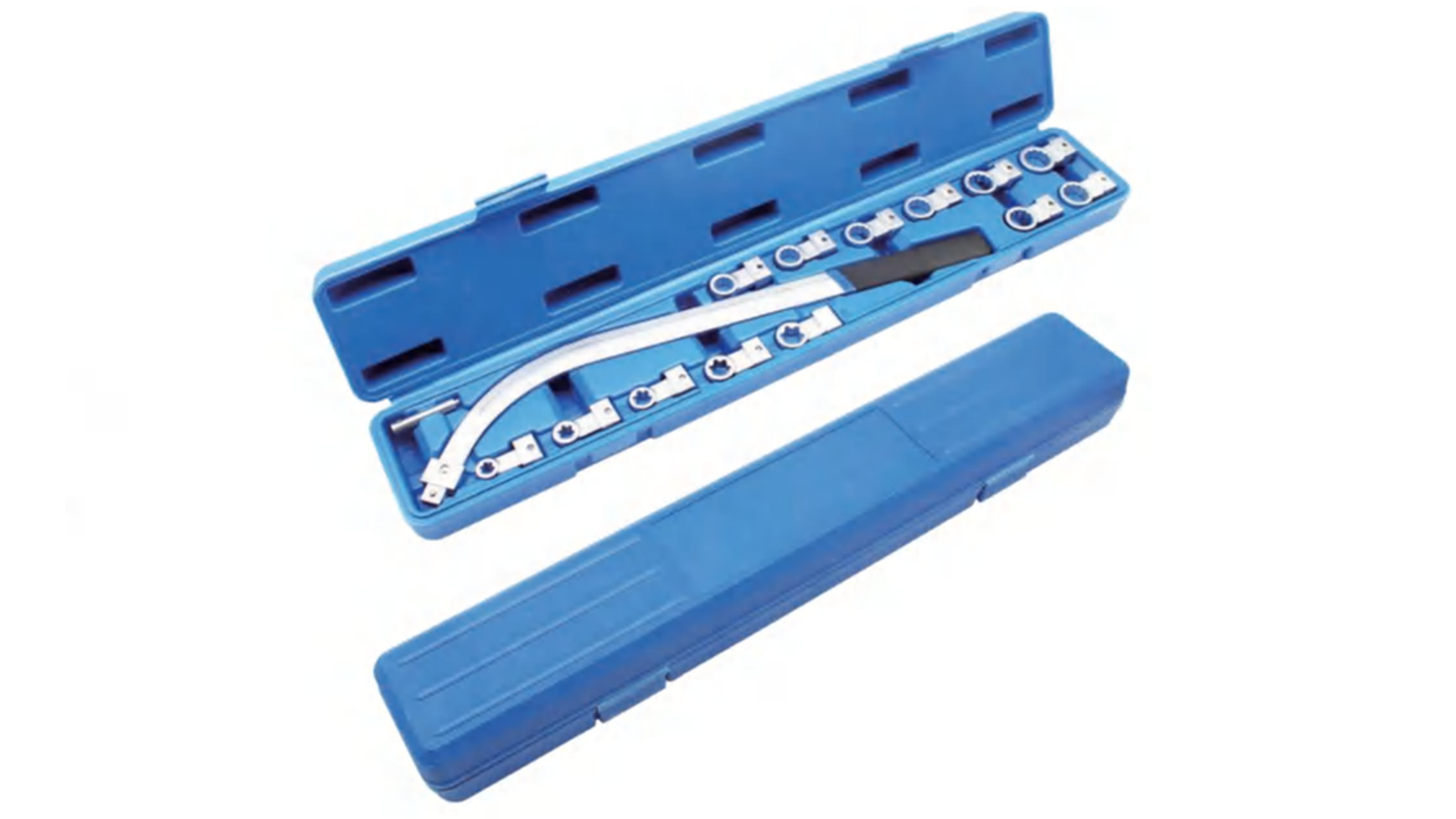
Makers answer this directly with access-oriented designs — long or slender bodies, thin profiles, extensions, and repositionable heads. That is why a tensioner wrench set is often long and slim rather than a standard-format wrench: the geometry, not just the size, gets the tool onto the tensioner. Confirm the clearance around the tensioner before settling on a format.
6. How Tool Length and Geometry Affect Reach
Length and geometry set the reach and the leverage a set provides. A longer handle gives more reach to a recessed tensioner and more turning force at the tool head; a thinner body fits into narrower gaps; and a repositionable head helps where a straight tool cannot be squared up.
These are physical properties, not marketing points: turning force increases with the distance from the pivot, so handle length has a real effect on how a stiff tensioner moves. Compare the published length and head design against the access you expect, and check the working angle is achievable.
7. Why Vehicle Name Alone Is Not Enough
A vehicle name does not by itself tell you the tensioner interface, the tool sizes needed, or the clearance around the belt drive. The same vehicle line can present different belt systems and tensioner arrangements across engine variants, so a model name alone does not confirm which tool will reach and turn the tensioner.
Manufacturers document their tensioner tools by engine or engine family, not by a single vehicle name, which shows the interface and belt system are the deciding references. Treat a vehicle or engine reference as a starting point for confirmation, not proof that a tool fits.
8. What Buyers Should Verify in the Kit Contents
When a set is quoted, verify the contents by item rather than by the headline count:
The interface types the pieces are meant to engage.
The E-profile sizes included, listed individually.
The twelve-point (or other) sizes included, listed individually.
The wrench or handle length, and the working length it provides.
The body thickness and head design, against the clearance you expect.
The storage/case format, and whether the pieces you need are present.
A contents list that gives the piece count but not the individual sizes is not yet a specification. This breakdown is what makes two sets comparable.
9. What Distributors Should Document Before Ordering
The itemised contents, by size, not only the piece count.
The interface each piece is intended to engage.
The wrench/handle length and the body thickness.
The tensioner applications the set is intended to cover.
The storage format.
These fields let a distributor compare two sets on the same basis and hold a supplier to the configuration that was quoted.
10. TEKO Confirmed Configuration — FJ02-S10
FJ02-S10, the 15pcs Belt Tensioner Wrench Set, is documented for belt tensioner service work. The contents are one long curved wrench, one key, five pieces (E10, E12, E14, E16, E18) and eight twelve-point pieces (12, 13, 14, 15, 16, 17, 18, 19 mm). The listed material is 42# CR-MO steel with a nickel plating finish, the documented wrench length is 450 mm, and the weight is 1.6 kg. It is packed as a box, QTY 10, G.W./N.W. 16/15 kg, MEAS 62×35.5×21.5 cm, in the Engine Service Tools range.
Use the published size list, 450 mm length and confirmed kit contents as the product reference. Application fit should still be checked against the target tensioner layout and available engine-bay access. Send the interface, the required sizes and the access conditions on your applications so the configuration can be checked against them. For different packaging, labeling or branding, send the requirement with your inquiry.
11. Frequently Asked Questions
Does a size list confirm that a belt tensioner wrench set will fit?
No. A size list shows which fasteners the set can engage, not whether the tool reaches the tensioner in the engine bay. Confirm the interface and the access as well as the sizes.
Why does the tensioner interface matter?
Tensioner pulleys use different interfaces — hex sizes, square drives, twelve-point shapes, E-profile sizes, and some pin or housing designs. A tool has to match the actual interface, so confirm it first.
Why can a tool with the right sizes still not fit?
Because a size fit is not an access fit. If the body is too thick or the handle too short for the space around the tensioner, the tool cannot be positioned or turned even though it carries the right size.
Is the vehicle name enough to choose the tool?
Not by itself. The same vehicle line can use different belt systems and tensioner arrangements, so confirm the interface and access on the specific application.
What should distributors confirm before ordering a belt tensioner wrench set?
The itemised sizes, the interface each piece engages, the wrench length and body thickness, the tensioner applications the set is intended to cover, the storage format, and packaging or private-label options.
12. Request a Configuration Check
Send us the belt tensioner applications and kit configuration you need to cover, and we will confirm which available configuration fits your program.
---