Oct 13, 2026Buyer Guides
What Should Buyers Check in an Auto Trim Removal Tool Kit?
Compare auto trim removal tool kits by material, tool profiles, clip and fastener functions and application boundaries — not by piece count alone.
1. Quick Answer
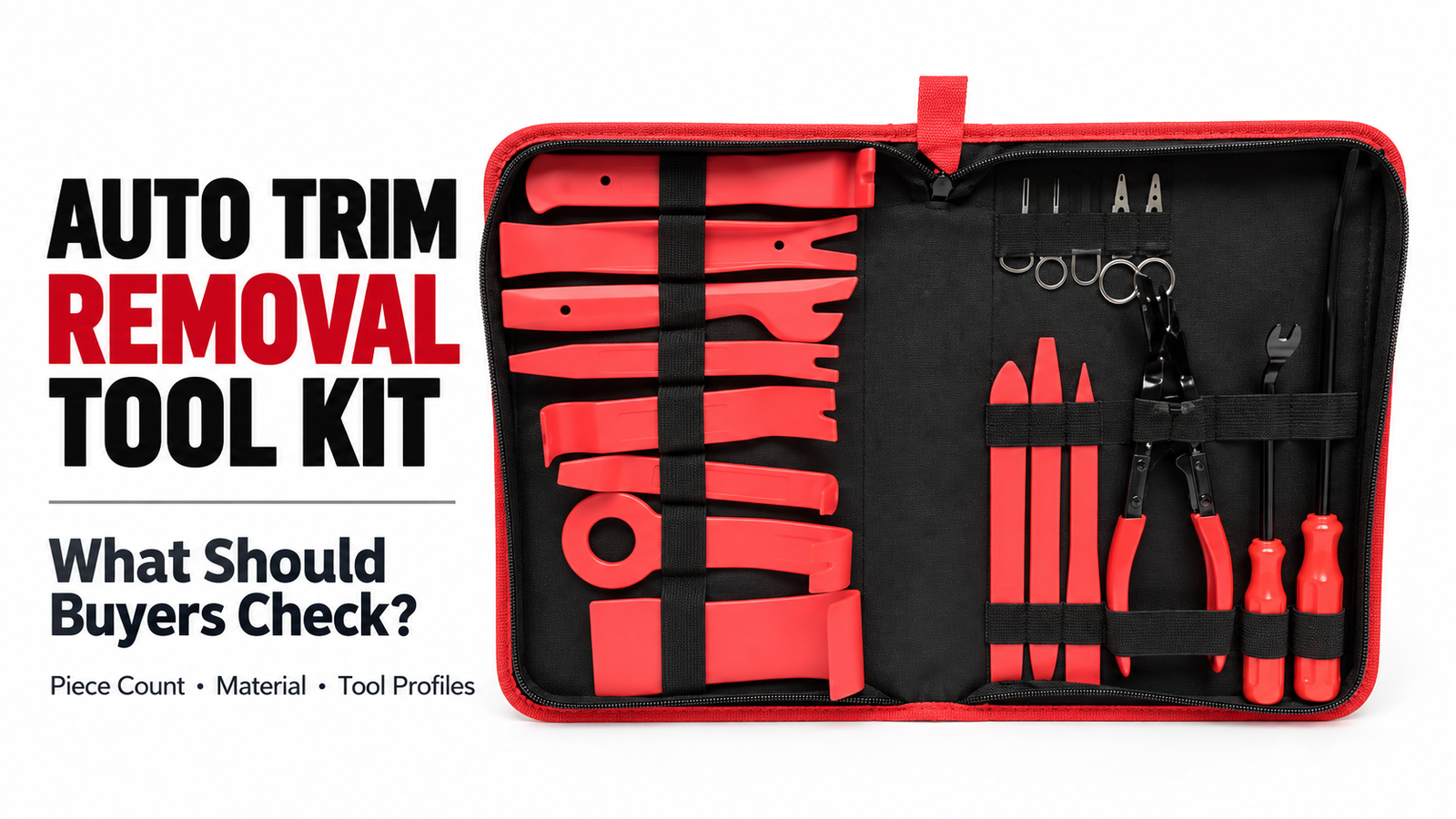
Piece count alone should not decide an auto trim removal kit. Two kits can both say "19 pieces" and still cover different tasks, because a count includes non-pry items — in one 19-piece set, only 11 pieces are interior trim (pry) tools and 1 is a clip plier, while the rest are stereo-removal tools and terminal-removal tools (the storage bag is a separate storage item, not one of the 19). Compare what contacts the vehicle: the material, the different pry profiles, whether real clip and fastener tools are present, and which clip types the kit handles.
Boundary: this guide covers trim, panel and fastener-removal kits. It does not cover windshield adhesive cutting or glass-removal tools.
2. Why Piece Count Alone Does Not Define Useful Coverage
A piece count is a packaging number. It tells you how many objects are in the bag, not how much trim work the kit can do. It also mixes categories: wide pry bars, narrow pry picks, a clip plier, and small metal tools for stereo and terminal removal are all counted as "pieces" but do different jobs.
Break the number down: how many are pry tools, how many are pliers, and how many are single-purpose accessories. A higher count is not automatically broader — it may simply add a scraper, extra terminals or a container.
3. Material: What Buyers Should Confirm
Material affects rigidity, contact behaviour and task suitability, so it is a selection variable buyers should verify against the intended application rather than assume. Plastics such as nylon are used where a tool flexes against a panel; steel tools appear where more leverage is needed.
The check is not "plastic is always gentle" or "metal always damages." Material sets how a tool behaves: a flexible plastic pry tool distributes force differently from a rigid steel one, and each suits a different contact and prying condition. Confirm the material of the tools that touch the vehicle, and match it to the panel and access conditions.
4. Tool Profiles: Different Shapes Should Serve Different Tasks
Trim kits include several tool shapes because trim and clips are reached in different ways and angles. Shapes commonly described by makers include flat and angled tips, forked and hooked ends, and U-notch and V-notch edges; tip widths also vary, from narrow picks to wide panel bars.
That is why profile variety matters more than a raw count. Many bars in the same shape do not add coverage the way fewer, differently shaped tools do. Confirm the shapes match the work: a wide bar for door-panel tabs, a notch for a push-clip, an angled tip for a recessed edge.
5. Pry Tools vs Clip and Fastener Removal Tools
The tools that lift a panel and the tools that release a clip are different functions, and good kits separate them. A pry tool levers a panel or trim away from its seat; a clip or fastener tool grips, squeezes or pulls the clip itself. Manufacturers sell these as distinct tools — clip pliers with shaped jaws for specific clip classes, and pry wedges for panels.
So a kit should be checked for both functions: enough pry profiles for the panel work, and a proper clip tool (not just a wedge) for the fasteners. A kit with many pry bars but no real clip plier is incomplete for clip-heavy interior work.
6. Why Clip and Fastener Types Matter
Clip and fastener designs vary, and a tool that suits one may not suit another. Makers distinguish, for example, push-pin fasteners with a centre pin, standard panel clips without a pin, and other named clip styles, and shape plier jaws to each. Because the clip is the point of contact, the kit's ability to handle the clip styles in your vehicles is a real selection question.
Fasteners also carry a removal risk. Clips and trim fasteners can be single-use or deform on removal; automotive authorities and estimating references note that such fasteners may not be suitable for reuse even when they do not look damaged. Tools that lift a clip by its head, or grip it side-on, reduce that risk. Confirm the clip types the kit is intended to handle.
7. Application Boundaries: What This Type of Kit Does Not Cover
This guide covers trim, panel and fastener-removal kits. It does not cover windshield adhesive cutting or glass-removal tools.
Within their scope, plastic and composite trim tools are made for trim, panels and clips. Where heavier prying is required, makers offer steel and impact tools as separate products — the boundary between a trim kit and a heavier-duty tool. A trim kit is the light, contact-sensitive option, not the tool for every prying task. Confirming the task avoids buying a set for work it was not designed for.
8. How to Review Kit Contents Before Ordering
Before ordering, work through the contents line by line rather than the headline number:
Count the pry tools separately from the pliers and the accessories.
Confirm the material of the tools that touch the vehicle.
List the pry profiles included, and match them to the panel and clip tasks.
Confirm a clip/fastener tool is present, and which clip types it targets.
Check the storage format and the packaging for your program.
A contents list that gives the count but not the breakdown is not yet a specification.
9. What Distributors Should Ask a Supplier to Document
The itemised contents, by tool type, not only the total piece count.
The material of each contact tool.
The pry profiles included, and their intended tasks.
The clip/fastener tools included, and the clip types they are intended for.
The application scope of the kit, and its limits.
The storage format.
These fields let a distributor compare two kits on the same basis, and hold a supplier to the quoted configuration.
10. TEKO Confirmed Configuration — FJ01-030
FJ01-030, the 19pcs Auto Trim Removal Tool & Clip Plier Fastener Remover, is a 19-piece trim removal set with clip plier for interior and panel work. The documented contents are 11 interior trim tools, 1 clip plier, 2 upholstery fastener removers, 2 stainless steel stereo removal tools and 3 stainless steel car terminal removal tools, supplied with a portable storage bag. The materials are nylon, carbon steel, 301 stainless steel and Q195 steel. It is documented for trim, clip and fastener removal during interior and panel work, including car audio and radio trim work, door panel work, window-area trim work and automotive interior repair. It sits in the Body, Trim & Glass Tools range.
The published material does not list individual tool lengths, tip angles, a clip-type compatibility table or a vehicle fitment list. Send the trim and clip work you need to cover so the configuration can be checked. For different packaging, labeling or branding, send the requirement with your inquiry.
11. Frequently Asked Questions
Does a higher piece count mean more trim coverage?
Not directly. Counts include non-pry items such as stereo keys and terminal tools (a storage bag is supplied separately and is not part of the count). Compare how many pieces are pry tools, how many are pliers, and which clip types the kit covers.
What material should auto trim tools be?
It depends on the task. Material affects rigidity and suitability: flexible plastics such as nylon for contact-sensitive panel work, steel where more leverage is needed. Confirm it against the intended application.
What is the difference between a pry tool and a clip plier?
A pry tool levers a panel or trim away; a clip plier grips, squeezes or pulls the clip itself. They are different functions, and a kit for clip-heavy work should include both.
Does a trim removal kit work for windshield or glass removal?
No. This type of kit is for trim, panels and fasteners. It does not cover windshield adhesive cutting or glass-removal tools.
What should distributors confirm before ordering a trim removal kit?
The itemised contents by tool type (not just the count), the material of the contact tools, the pry profiles, the clip/fastener tools and their intended clip types, the application scope and limits, the storage format, and packaging or private-label options.
12. Request a Configuration Check
Send us the trim-removal applications and kit configuration you need to cover, and we will confirm which available configuration fits your program.
---