Oct 12, 2026Buyer Guides
How to Choose a Thread Repair Kit: Thread Size, Pitch, Insert Length & Kit Contents
Compare thread repair kits by thread standard, size, pitch, insert length and included tooling — why piece count and a size like M8 are not a complete specification.
1. Quick Answer
A thread repair kit is selected by the threads it can actually repair, not by the number of pieces in the case. Two kits that both say "131 pieces" can cover different thread standards, sizes, pitches, insert lengths and tooling. The specifications that decide whether a kit fits a job are the thread standard, the size and pitch together, the insert length, and the tools matched to each size. A bare size such as "M8" is not a complete specification.
2. Why Piece Count Is Not a Thread-Coverage Specification
A piece count describes how much is in the box, not what it covers. Manufacturers themselves number their repair assortments by total count while describing the contents only as inserts "of various sizes and lengths" — the count does not say which sizes, pitches or insert lengths, or how many of each. One maker's workshop kit covers M5–M12, yet supplies ten pieces of the smaller sizes in three lengths and only five of the largest.
For a buyer, the piece count tells you the total number of components in the assortment, not the thread coverage. Compare the kit by its per-size, per-pitch and per-length breakdown and by the tooling supplied.
3. Thread Standard: Metric vs UNC vs UNF
Thread repair inserts are catalogued by thread standard, and the standard is a separate selection axis, not a cosmetic difference. The common families are metric ISO coarse and fine, and the unified inch families UNC (coarse) and UNF (fine); imperial catalogues also carry BSW and BSF. Each family has its own sizes, pitch values and taps.
So the first question is not how many pieces, but which standard the target threads belong to. A metric kit does not repair an UNC thread even when the two are close in diameter, because the pitch and receiving thread differ.
4. Why Thread Size and Pitch Must Be Confirmed Together
A size on its own is ambiguous. "M8" maps to more than one catalogued product: M8×1.25 and M8×1.0 are different thread specifications and require different STI taps. The preparation drill or other tooling must follow the data for the specific insert system rather than being inferred from the nominal size alone. The same holds higher up — M10 appears as ×1.50, ×1.25 and ×1.00, and M12 as ×1.75, ×1.50 and ×1.25. Manufacturer tables list these as separate rows for exactly that reason.
Practically, "M8 thread repair kit" is not yet a specification. The buying question is M8 at which pitch. Two suppliers can both answer "yes, we have M8" and still ship different products.
5. Insert Length: Why M8 Alone Is Not a Complete Specification
Insert length is a third required dimension, expressed in multiples of the nominal diameter — commonly 1D, 1.5D, 2D, 2.5D and 3D. The same M8×1.25 insert comes in several lengths, and the length changes how much thread the repair provides.
Length is not a free choice; it is tied to the parent material and the screw's property class. Insert makers publish selection guidance keyed to the strength of the material being repaired — a stronger base material can take a shorter insert, while softer materials call for a longer one. Note too that "nominal length" is a calculated designation, not a figure measured off a loose insert. The full specification is the designation: diameter × pitch × length.
6. What Tools Should Be Matched in a Complete Repair Kit
For each thread size covered by a complete kit, the preparation and installation tooling must be matched to that repair size and insert system.
The tap to check is the STI tap. STI stands for Screw Thread Insert: it cuts a receiving thread larger than the finished thread but keeps the same pitch, because the insert occupies the difference. A standard tap of the nominal size is too small, and the next size up has the wrong pitch, so the tap must be matched to the insert system.
The drill follows from the system too. Drill values for a given thread differ between insert systems, because the receiving thread differs. Ask the supplier for the drill matched to the kit you are offered, not a number from a fixed table.
7. Single-Size Kit vs Multi-Size Assortment vs Refill Pack
These are three different products. A single-size kit is complete for one thread size — one drill, one tap, one installation tool, one insert supply. A multi-size assortment gathers several sizes in one case, ideally with matched tooling per size. A refill pack typically supplies replacement inserts without the full repair tooling, for a size or system the workshop already supports.
In an assortment, check that each size carries its own matched tooling, and treat the case's total count as separate from its coverage. For ongoing work, check which sizes are sold as refills: the kit is bought once, but the inserts are replaced as they are used.
8. What Distributors Should Ask a Supplier to Document
Thread standard (metric, UNC, UNF, or another family).
Every size together with its pitch, not the size alone.
The insert length (or lengths) supplied for each size.
The quantity of inserts per size and per length.
Whether each size has its own matching drill and STI tap.
The installation tool, and whether a tang-break tool is included or the inserts are tangless.
Whether inserts can be reordered as refills.
The case or layout, instructions and labeling.
A quote that lists only a piece count is not yet comparable. These fields let two kits be compared on the same basis.
9. TEKO Confirmed Configuration
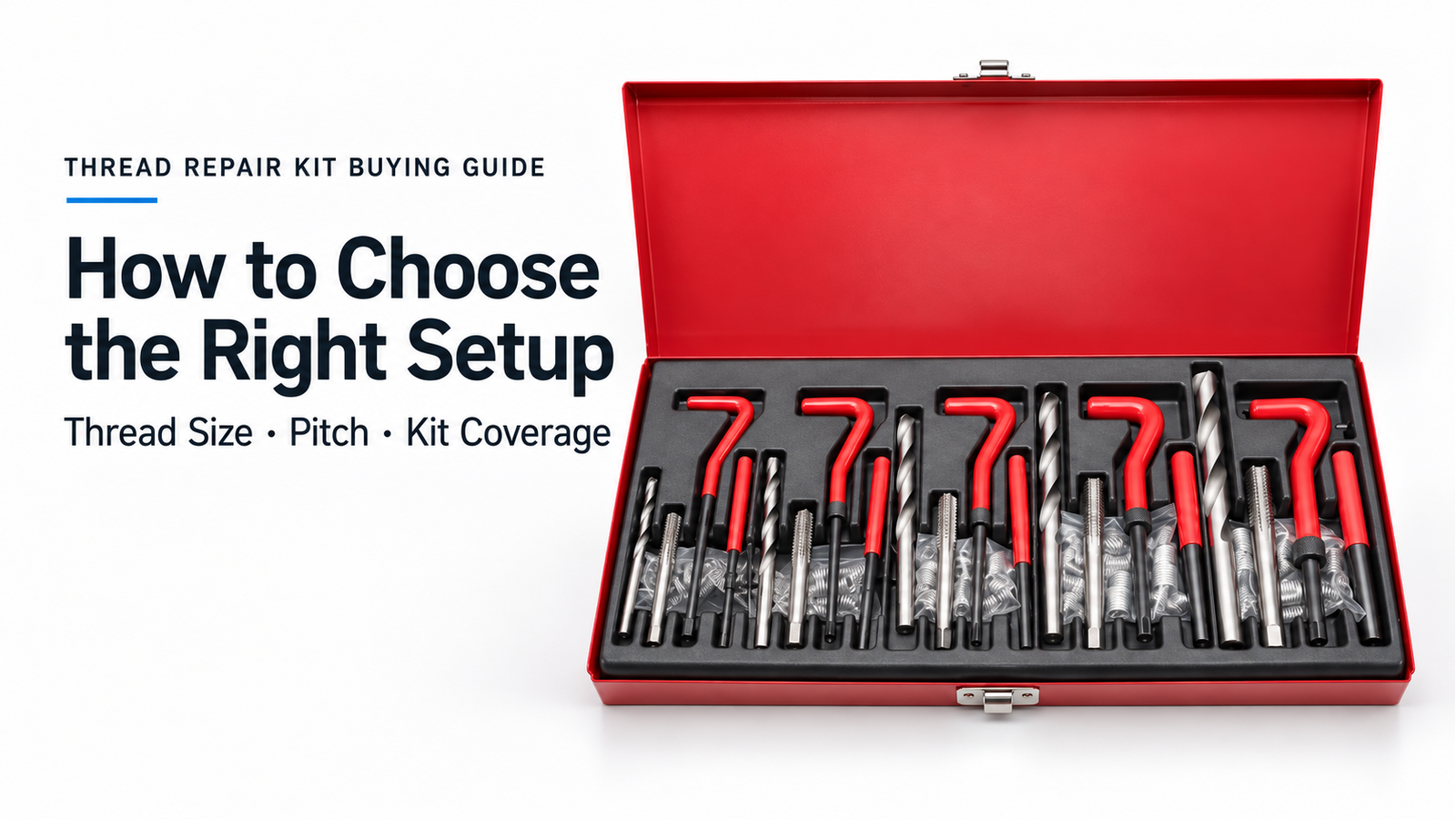
TEKO's 131pcs Thread Repair Kit is a 131-piece set in a steel box for repairing damaged threads. The documented specification covers five metric thread sizes with their pitches — M5×0.8, M6×1.0, M8×1.25, M10×1.5 and M12×1.75 — in bearing steel with a blackening treatment. It measures 38.4×19×4 cm, weighs 2.15 kg, and is packed as a steel box, QTY 10, G.W./N.W. 21.5/20.8 kg, MEAS 40×40×20 cm. It sits in the Automotive Specialty Hand Tools range.
The published material does not itemise the 131 pieces, so the insert lengths, the quantity of inserts per size, and the specific drill, tap and installation tooling are not stated here. A buyer with a coverage requirement should send the standard, sizes and pitches they need so the configuration can be checked. For different packaging, labeling or branding, send the requirement with your inquiry so it can be reviewed case by case.
10. Frequently Asked Questions
What size thread repair kit do I need?
Start from the thread you are repairing — its standard, diameter and pitch — then check the kit covers that combination. Size alone is not enough, because the same diameter exists at more than one pitch.
Is thread size enough, or do I also need to know the pitch?
You need both. "M8" resolves to more than one product, such as M8×1.25 and M8×1.0, which are different thread specifications and require different STI taps.
What is the difference between a thread repair kit and an insert refill pack?
A kit carries the tooling — drill, tap, installation tool and a tang-break tool where used — plus a supply of inserts. A refill pack typically supplies replacement inserts without the full repair tooling, for a size or system the workshop already supports.
Does a larger piece-count kit cover more thread sizes?
Not necessarily. The count does not state which sizes, pitches or insert lengths are included, or how many of each.
What should distributors confirm before ordering a wire thread insert repair kit?
The thread standard; each size with its pitch; the insert length per size; the quantity per size and length; the matching drill and STI tap per size; the installation tool and whether a tang-break tool is needed; refill availability; and the case, instructions and packaging.
11. Request a Configuration Check
Send us the thread sizes, pitches and kit configuration you need, and we will confirm what the available configuration can support.
---