Oct 10, 2026Buyer Guides
Piston Ring Compressor Size Guide: How to Match Diameter, Band Size and Kit Coverage
Compare piston ring compressor sizes by bore diameter and band coverage: why the overall kit range is not enough, and what buyers should confirm before ordering.
1. Quick Answer
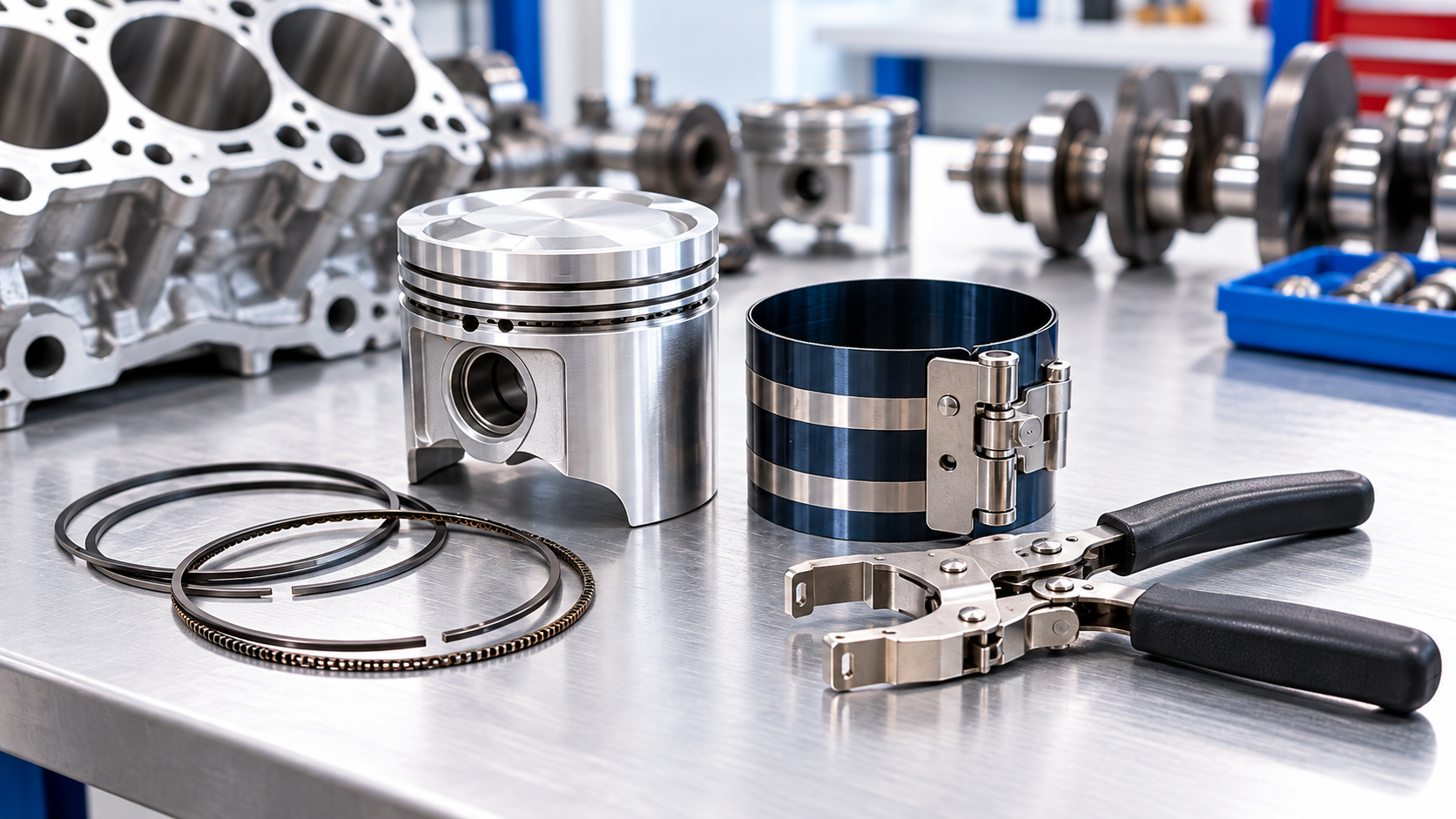
Piston ring compressors are selected by diameter, not by piece count or the word universal. Two figures matter: the piston or bore diameter you are working with, and the diameter range each band or compressor actually covers. A kit that lists only an overall range — for example 2-7/8″ to 4-3/8″ — tells you the outer limits, not which band fits which bore. Buyers should confirm the band-by-band coverage before comparing sets.
2. Why Diameter Is the First Selection Question
A ring compressor has one job: to hold the piston rings compressed while the piston is fitted into the bore. That means the tool has to match the diameter it is working on. Manufacturers publish these tools by diameter range for exactly that reason: one maker states an adjustable handle gives an effective size range for rings from 2.125″ to 5.0″, another lists a range of 2-1/8″ to 5″, and a third publishes bore-diameter ranges per model. The two broad families differ in how that range is expressed — a fixed-size compressor is sized for a bore or a narrow range, while an adjustable or band type covers a spread of diameters by using different bands against the piston.
So the first question from a supplier is not the piece count; it is what diameter the buyer is working with, and whether the tool’s published coverage reaches it. One term to keep straight: sizing references are not identical between makers. Some publish the size as the piston or ring diameter the tool fits; a bore-specific tool may instead be published by cylinder bore diameter, sometimes for a specific engine family. Buyers should confirm the sizing reference on the supplier’s own documentation before comparing figures, rather than assuming every listing uses the same basis. Starting from the diameter you are working with and working back to the tool avoids the common mistake of buying a kit because the piece count looked generous.
3. Overall Kit Range vs Individual Band Coverage
Most piston ring compressor listings get read incorrectly here. A published overall range such as 73–111 mm is the combined span of every band — the outside limits, not the resolution. What a buyer actually needs is the band-by-band table: each band’s own diameter range, and whether neighbouring bands sit next to each other or leave gaps.
The reason is practical. If only the total range is published, a buyer cannot tell which band covers a 3.5-inch piston, or map a target diameter to the band that is meant to cover it. When a kit documents its coverage band by band, the buyer can match each of their target diameters to a specific band before ordering. That documentation is not universal: some manufacturers publish both a total range and each band’s sub-range, while others publish only the overall figure. When the coverage table is missing, the correct move is to ask the supplier for it — a quoted band-by-band table is what makes two kits comparable on the same basis.
For quotation and incoming inspection this matters twice: whether the kit meets the requirement, and later whether each band matches what was quoted.
4. How Multi-Band Pliers Sets Work
A multi-band set pairs one plier with several interchangeable bands. The plier carries the mechanism that holds the band closed: manufacturers variously describe a ratcheting lock, a fine-tooth ratchet, or a spring-clutch locking action. The bands are sized to diameters, so the operator swaps bands to match the piston being fitted. That is why the piece count is not the useful number: “7 pieces” means one plier and six bands, and it is the six bands’ diameters that decide coverage.
Manufacturers document these sets by listing the band diameters and the mechanism, so a buyer can verify both the coverage and the way the tool holds the band — specification fields to check, not marketing lines.
5. Adjustable Band vs Fixed-Size Compressor
A multi-band plier set covers a spread of diameters by swapping bands, which suits a workshop or a distributor serving several engine families. A fixed-size compressor is matched to a single bore or a narrow range — some manufacturers publish a dedicated tool for one piston diameter, tied to specific engine families. That can be the simpler and more repeatable choice when a shop rebuilds the same engine type again and again. Neither is universally better: the deciding factors are how many different diameters the buyer has to cover and how often the same one comes up.
6. What Buyers Should Ask a Supplier to Document
Overall diameter coverage: the outer limits of the kit.
Individual band sizes: the diameter range of each band, not just the total.
Plier and mechanism: how the band is closed and held, and whether a ratchet or lock is documented.
Kit contents: what the piece count is actually made of.
Material and any documented vertical or horizontal use, where the maker states it.
Storage case, replacement bands, and instructions where documented.
Packaging and private-label options for the order.
TEKO’s 7pcs Piston Ring Compressor Set, for example, is a 7-piece set documented for piston and ring installation during engine service, with one ratchet plier and six rings. Its coverage is documented band by band:
Band 1 — 2-7/8″ to 3-1/8″ — 73–79 mm
Band 2 — 3-1/8″ to 3-3/8″ — 79–86 mm
Band 3 — 3-3/8″ to 3-5/8″ — 86–92 mm
Band 4 — 3-5/8″ to 3-7/8″ — 92–98 mm
Band 5 — 3-7/8″ to 4-1/8″ — 98–105 mm
Band 6 — 4-1/8″ to 4-3/8″ — 105–111 mm
Overall documented coverage: 2-7/8″ to 4-3/8″ (73–111 mm).
The set sits in the Engine Service Tools range, and a buyer sets their target diameters against the six listed ranges rather than a single headline number.
Send us the diameter range and kit configuration you need through our inquiry form — the bore or piston diameters you serve, the required band coverage, your preferred kit configuration, quantity, and any private label or OEM requirements, branding or packaging requirements — and we will confirm what we can support.
Frequently Asked Questions
What size piston ring compressor do I need?
Match the tool to the diameter you are working on. Confirm the piston or bore diameter first, then check that the compressor’s published band coverage reaches it. A kit sized by individual bands lets you match each target diameter to a specific band.
Is piston ring compressor size based on the bore diameter?
It can be, but the reference varies between suppliers. Some publish the size as the piston or ring diameter the tool fits; a bore-specific tool may be published by cylinder bore diameter. Confirm the manufacturer’s stated sizing reference before comparing, and use the diameter figure rather than the piece count or a universal label.
Is a 7-piece set automatically more versatile?
No. Two 7-piece sets can cover different diameter ranges. In a plier-and-band system, compare the individual band ranges and the total documented coverage, not the piece count alone.
What is the difference between a band compressor and a fixed-size compressor?
A band compressor works with interchangeable bands to cover a spread of diameters, while a fixed-size compressor is matched to a single bore or a narrow range, sometimes tied to a specific engine family. The choice depends on how many diameters you need to cover and how often the same one recurs.
What should distributors confirm before ordering a piston ring compressor set?
The overall diameter coverage, the individual band sizes, the plier and its locking mechanism, the written kit contents, material and documented use, storage case, replacement bands, instructions, and packaging or private-label options.