Oct 12, 2026Buyer Guides
How to Choose CV Boot Clamp Pliers: Clamp Type, Band Width, Tool Function & Access
Compare CV boot clamp tools by clamp type, band width, tool function and access — why a CV boot clamp tool is not one interchangeable tool type.
1. Quick Answer
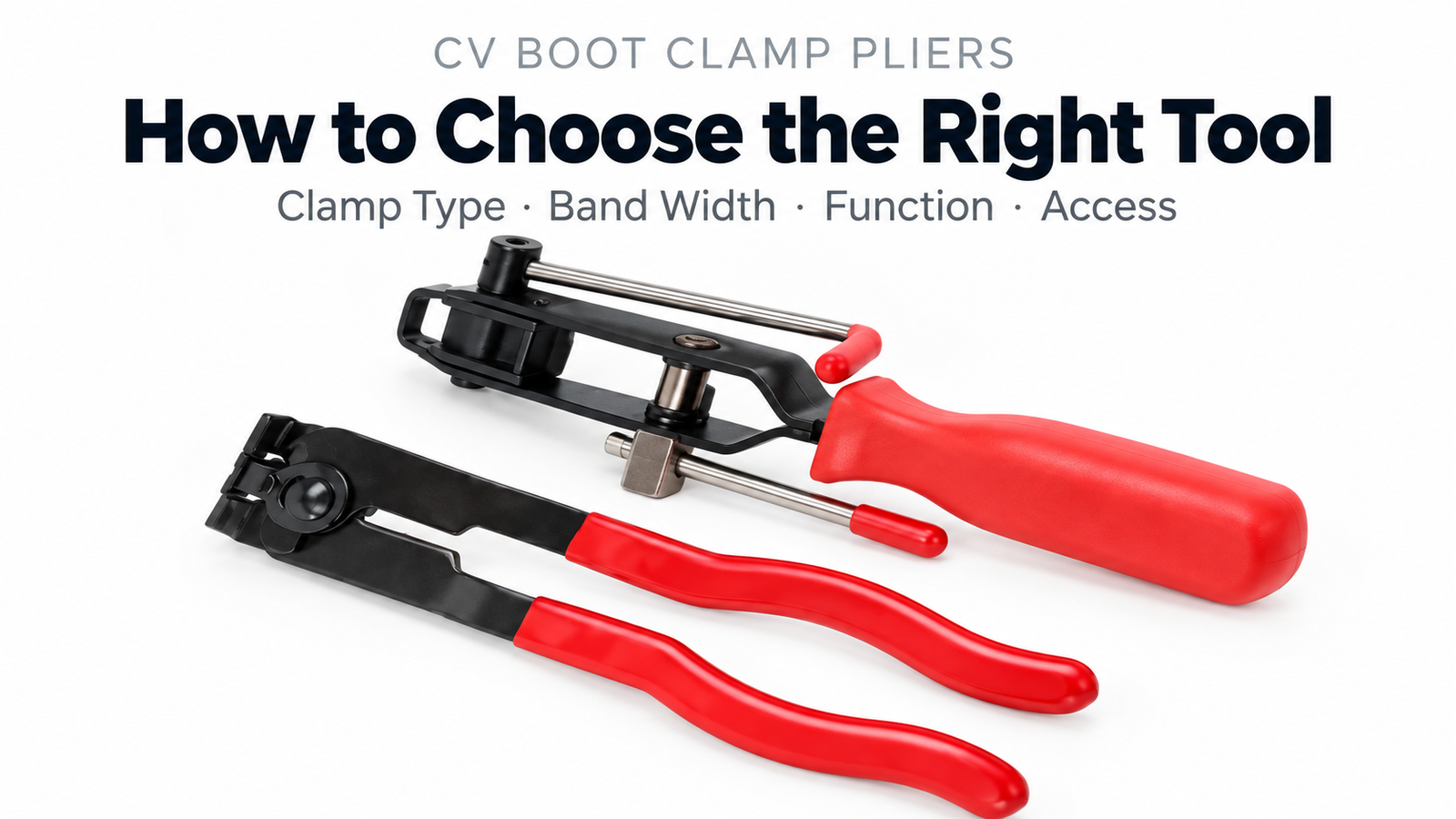
A CV boot clamp tool is not one tool type. CV boots are secured with different clamp designs — ear-type clamps, banding straps and earless flat bands — and each is installed with a different mechanism: crimping, or tensioning and cutting. Before comparing tools, confirm which clamp the job uses, because the same generic name covers tools that do not do the same thing. Clamp type decides the tool; band width and access decide which version of it.
2. Why "CV Boot Clamp Tool" Is Not One Tool Type
The name "CV boot clamp tool" is a category label, not a specification. Manufacturers sell several distinct tools under near-identical names: an ear-type crimping plier and an earless clamp plier can share almost the same product name while performing incompatible jobs. One maker's line splits into separate part numbers by clamp type and adds a separate banding tool; another ships cutting, banding and installation tools as different items.
That naming collision is why buyers who order by name alone receive a tool that does not fit the clamp in front of them. Start from the clamp, not the tool name.
3. Ear-Type Clamps vs Banding Straps
The two most common families work in different ways.
Ear-type clamps carry a raised ear that is crimped down to close the clamp. The tool for these is a crimping plier, which squeezes the ear to secure the boot.
Banding straps are closed by tension. A banding tool winds and tightens the band around the boot, then cuts the surplus. Some banding tools let a socket or wrench be used on the handle to control the tightening.
An earless or flat-band clamp is a third case: it has no ear to crimp and is closed by gripping and tightening. A crimping plier for ear-type clamps will not close an earless clamp, and a banding tool is not needed for an ear-type clamp. Confirm which family the boot uses before choosing.
4. Why Band Width / Capacity Matters
A clamp tool is rated for a band width, and the band has to fall inside that rating. Manufacturers state working limits — one cutter is described for clamps up to a stated width and thickness, while another installer states a narrower limit. The clamp makers define band widths per series, and those widths vary across a product range.
So a tool that works on a narrow band may not reach around a wider one, and a tool rated too wide may not seat on a thin band. Match the tool's stated working width to the band you use, and treat the width as a specification to confirm.
5. Tensioning, Cutting and Crimping Are Different Functions
These are three separate actions, and they are not always in one tool.
Crimping closes an ear-type clamp. Tensioning winds a banding strap tight. Cutting removes the surplus after tensioning. Some makers list a banding tool that both tensions and cuts in one tool; others list a cutting tool as its own item. A set that includes a banding tool with a cutter and a separate crimping plier covers two functions but is not a universal clamp tool.
Before ordering, list the functions the job needs — crimp, tension, cut or a combination — and check that the set provides each one.
6. Why Access and Jaw Orientation Matter
CV joints are often in confined spaces, and access can rule out an otherwise correct tool. Tool makers address this with jaw geometry: an offset or side-jaw tool is designed to work from the side in hard-to-reach areas, where a straight, end-on tool cannot be positioned. Clamp-system suppliers describe side-jaw pincers for the same reason.
Access also interacts with tool length. A more compact tool can reach inner joints where a longer tool cannot be placed. Confirm the access conditions before settling on a jaw orientation.
7. When Torque-Controlled Installation Changes Tool Choice
Some clamp systems are closed to a controlled force, and that changes which tool works. At least one maker offers a clamp tool designed for use with a torque wrench where stainless-steel bands are specified, and another describes using a socket or wrench on the handle to tighten a band to specification. Clamp-system suppliers also provide closing-force gauges to verify installation tools.
Where the procedure calls for controlled tightening, a hand-crimp tool alone is not enough — the tool must accept the torque or force control required. Confirm whether controlled installation applies before choosing.
8. What Distributors Should Ask a Supplier to Document
The clamp type the tool is intended for (ear-type, banding strap, earless or flat-band).
The band width (and thickness, where stated) the tool works with.
Which functions the set performs — crimping, tensioning, cutting, or a combination.
Whether the tool accepts torque or force control where the procedure requires it.
The access conditions the tool is designed for, and any offset or compact variants.
What is included in the set, and whether the parts are available separately.
A description that gives only the name "CV boot clamp tool" is not yet a specification. These fields let two tools be compared on the same basis.
9. TEKO Confirmed Configuration
FJ05-067 is the 2pcs CV Joint Clamp Banding Tool & Boot Clamp Pliers Set — a 2-piece set comprising a clamp banding tool with cutter and a CV boot clamp plier. The documented working width is banding width up to 10 mm (also listed by the manufacturer as 2/5 in.). The stated applications cover ear-type hose clips on fuel hoses, cooling systems and vacuum hoses; CV joint boot clamp work including late-model GM CVJ; the source also lists steering gear gaiter and fuel-hose applications for VAG, Opel, BMW, Mercedes-Benz, Honda, Nissan and Mazda vehicles, and work on Oetiker System hose clamps. It is packed as a slide card, QTY 36, G.W./N.W. 19/18 kg, MEAS 44×35×38 cm, in the Automotive Specialty Hand Tools range.
The published material gives the two-piece contents, the 10 mm working width and the stated applications, but does not list a clamp-type compatibility table or a full band-width range beyond that width. A buyer with a specific requirement should send the clamp type and band width they need to cover, so the configuration can be checked against them. For different packaging, labeling or branding, send the requirement with your inquiry so it can be reviewed case by case.
10. Frequently Asked Questions
What type of pliers do I need for CV boot clamps?
It depends on the clamp. Ear-type clamps need a crimping plier; banding straps need a banding tool that tensions and cuts; earless or flat-band clamps need their own grip-and-tighten style. Confirm the clamp first.
What is the difference between an ear-type clamp plier and a banding tool?
An ear-type plier crimps the raised ear to close the clamp. A banding tool winds a strap tight and cuts the surplus. They do different jobs and are usually different tools.
Does one CV boot clamp tool fit every clamp style?
No. The same generic name covers tools with different mechanisms. A plier that crimps an ear-type clamp will not tension a banding strap, and a banding tool is not used on an ear-type clamp.
Why does band width matter when choosing a CV boot clamp tool?
The tool is rated for a band width, and the band must fall inside it. A tool rated too narrow will not reach around a wider band, and one rated too wide may not seat on a thin band. Match the tool's stated width to the band used.
When do I need an offset or torque-wrench-compatible clamp tool?
An offset or side-jaw tool is for confined access where a straight tool cannot be positioned. A torque-wrench-compatible tool is for clamp systems whose procedure calls for controlled tightening — for example, where stainless-steel bands are specified. Confirm access and the installation procedure before choosing.
11. Request a Configuration Check
Send us the clamp type and tool requirements you need to cover, and we will confirm whether the available configuration fits your program.
---