Oct 9, 2026How-To & Troubleshooting
Why Compression Test Readings Vary: What to Check Before Blaming the Gauge
Learn why compression test readings vary with engine temperature, cranking speed, throttle position, adapter fit and test setup.
1. Quick Answer
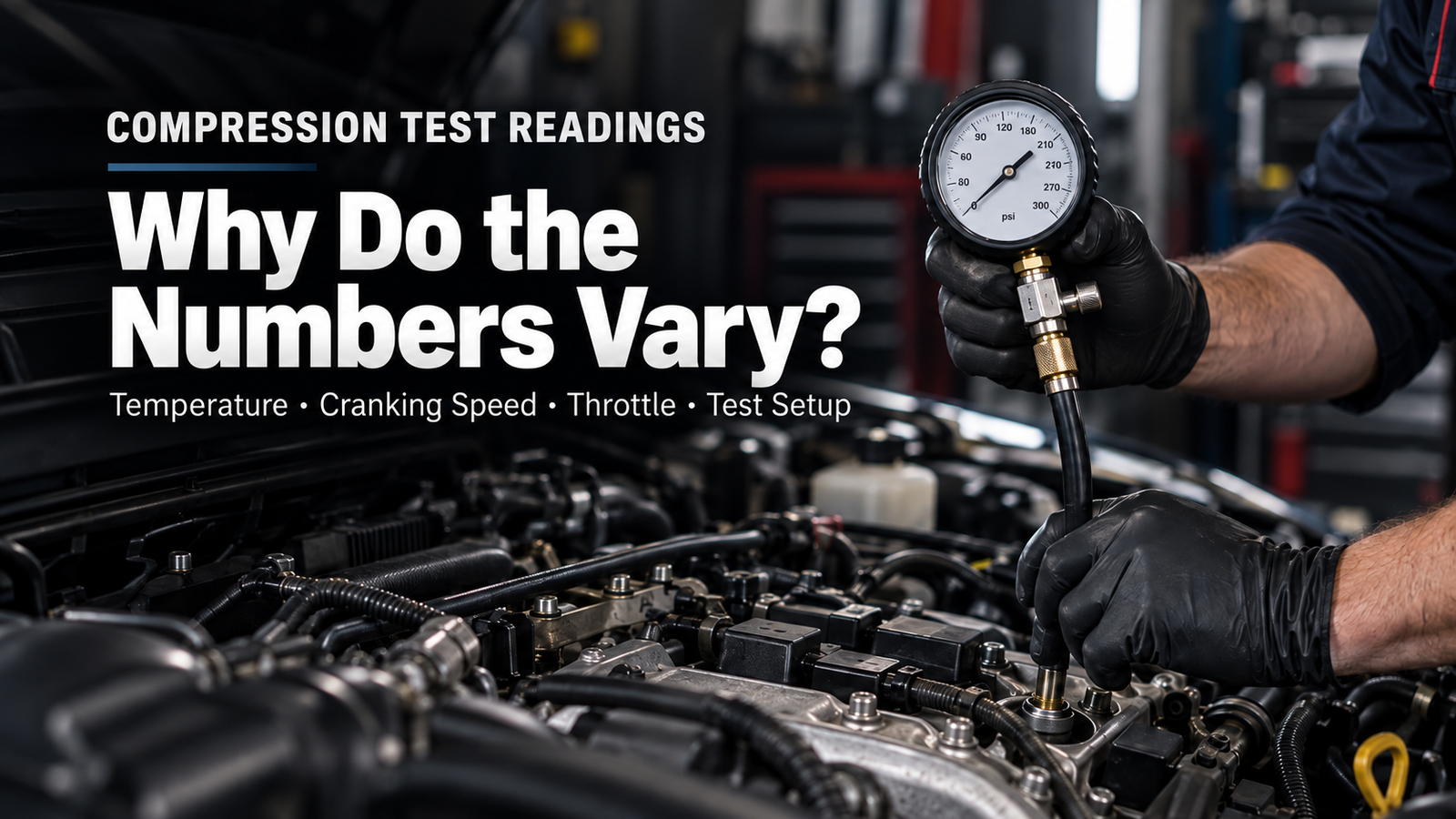
Compression readings can change when test conditions change. Engine temperature, cranking speed, throttle position, adapter fit and test setup should be controlled before an unexpected result is blamed on the gauge or the engine.
2. Why the Same Engine Can Produce Different Compression Readings
A compression test is a dynamic measurement: the gauge reads pressure produced while the engine is being cranked by the starter, not a fixed property of the engine alone. Tool instructions describe it that way — crank the engine for several compression strokes and watch the needle climb to a peak. Change the cranking conditions, the engine's temperature or the way the tester is connected, and that peak can move.
That is why a comparison only means something when the procedure stays consistent. Supplier instructions tell the user to test every cylinder the same way and compare the results against the vehicle manufacturer's specifications and the other cylinders. Readings taken under different conditions are not comparable.
3. Engine Temperature Changes the Test Condition
Published procedures commonly start with engine temperature: one tool maker's instruction sheet opens its compression test procedure with running the engine until it reaches normal operating temperature, and service manuals state the same requirement. A warm engine and a cold engine are two different test conditions, and a cold-morning reading is not automatically comparable with one taken after a full warm-up.
The documentation publishes no universal correction figure: control the temperature, keep it the same across cylinders, and compare like with like.
4. Cranking Speed and Battery Condition Matter
The reading is produced during cranking, so the cranking speed is part of the measurement. Service manuals tie this to the electrical system: one OEM procedure requires a fully charged battery so the engine turns at its specified minimum cranking speed, and another has the starter crank for a defined period while the maximum reading is recorded. A weak battery or dragging starter can slow cranking and change the peak the gauge reaches.
The specific speeds are OEM-specific. One manufacturer's minimum cranking speed cannot be read as an industry-wide figure — what transfers between engines is the principle: control battery and starter condition, and keep cranking consistent from cylinder to cylinder.
5. Throttle Position Can Change the Reading
Throttle position changes the airflow into the cylinders during the test, and published procedures control it. Tool instructions direct the user to remove the air filter and set the throttle plates to the wide-open throttle position before cranking; OEM procedures likewise say to fully open the throttle while measuring. The requirement is a consistent intake condition across cylinders — and the same documentation warns the user to return the throttle to closed before the engine is restarted.
6. Adapter Fit and Connections Are Part of the Measurement
The adapter is the contact point between the tester and the engine, and tool documentation treats it as part of the measurement. Kits document their adapter coverage explicitly: one professional kit lists 14 mm adapters in standard and long reach plus 10 mm and 18 mm versions; another lists 10 mm, 12 mm, 14 mm, 14 mm long reach and 18 mm. The adapter has to match the spark plug thread and plug well, and the installation guidance is specific — hand tight only, never with a wrench.
The documentation is equally specific about mismatches: a long-reach hose or adapter used in a short-reach hole can contact the piston, according to one tool maker's instructions. Connections are part of the same chain — couplings should be fully engaged, and adapters securely tightened to the hose so nothing separates on removal.
7. Repeat the Test Before Blaming the Gauge
When a reading comes out lower than expected, repeat the test under the same controlled conditions before treating the result as conclusive. Before concluding anything, confirm: the same procedure on every cylinder, consistent battery and starter cranking, matching engine temperature, correct throttle position, the correct adapter for thread and reach, a tight tester connection, and fully engaged couplings.
Only then does the comparison mean something: the results against the vehicle manufacturer's specification, and cylinder against cylinder under the same conditions. If the repeat test, run under controlled conditions, still shows one cylinder out of line with the others, the next step belongs to the vehicle's service information — not to the gauge.
8. What Tool Buyers Should Check in a Compression Tester Kit
Gauge and units: the dial range and whether it reads in one scale or two, as documented by the supplier.
Hose configuration: gauge-hose length, flexible hose options and quick-coupling arrangement.
Adapter sizes and reaches: which thread sizes are included, and whether standard and long reach are both covered.
Connections: quick couplers between hose and gauge, and how the adapters attach.
Test pipes and related components: the documented pipe and plug types for different spark plug well styles.
Release or reset mechanism: whether the kit documents a valve for relieving pressure between cylinder tests.
Written kit contents, instructions, storage case, and replacement or service parts where documented.
TEKO's 8pc Cylinder Compression Tester Kit, for example, sits in the Testing & Diagnostic Tools range and is documented for checking engine cylinder condition. The kit contains an air gauge with quick coupling and release valve, a soft long pipe, a crank shaft type test pipe and a transverse axis test pipe with rubber plugs, and four adapters — M10×1.0, M12×1.25, M14×1.25 and M18×1.25. The published contents are the specification a buyer checks against the engines and spark plug threads in the target market. For how requirements differ between fuel types, see Gasoline vs Diesel Compression Testers.
9. When Low Compression May Be an Engine Issue
If the test has been repeated under controlled conditions — same procedure, consistent cranking, correct temperature and throttle position, correct adapter and tight connections — and one cylinder still reads out of line with the others, the next step is to investigate engine-side causes using the vehicle manufacturer's service information. Service manuals treat the reading as an indicator of the cylinder's internal condition; what to do next belongs to the vehicle's service information.
If you are sourcing compression testers for your market, send us your tester and market requirements through our inquiry form, along with the engines and spark plug thread sizes you serve, your required kit configuration, quantity, any private label or OEM requirements, and packaging requirements — and we will confirm what we can support.
Frequently Asked Questions
Why do compression test readings vary?
Because the reading is produced during cranking and depends on the test conditions: engine temperature, cranking speed, throttle position, adapter fit and the tester connections. Change any of these and the peak reading can change.
Can a weak battery affect a compression test?
Yes. OEM procedures tie the test to cranking speed and require a fully charged battery so the engine cranks as specified. A weak battery can reduce cranking speed and affect the peak reading the gauge reaches.
Does the engine need to be warm for a compression test?
Published procedures commonly require it: tool instructions and OEM procedures state that the engine should reach normal operating temperature before testing. The consistent part is keeping the condition the same across all cylinders.
Can the wrong adapter cause a bad compression reading?
It can affect the test. The adapter has to match the spark plug thread and reach, be installed by hand and connect tightly to the hose. Tool documentation also warns that a long-reach adapter or hose used in a short-reach well can contact the piston.
Should compression readings be compared with other cylinders or an OEM specification?
With both, under the same test conditions: the results against the vehicle manufacturer's specification, and cylinder against cylinder. Comparisons across different conditions are not meaningful.