Oct 13, 2026Tool Knowledge & Comparisons
Ball Joint Separator vs Puller vs Press: Which Tool Type Fits the Job?
Compare ball joint separators, pullers and presses: what each tool does, why jaw opening and access decide the choice, and why a vehicle name is not enough.
1. Quick Answer
A ball joint separator, a puller and a ball joint press are three different tools for three different jobs. A separator or splitter breaks a tapered ball-joint stud out of its seat. A puller uses jaws and a forcing screw to draw a tapered arm off a shaft. A press pushes a press-fit joint in or out of a bore. Choosing by the vehicle name, or by the word "ball joint tool", does not tell you which of the three the job needs — the joint design and the access decide.
2. Why "Ball Joint Tool" Is Too Broad
"Ball joint tool" describes a category, not a task. Under that name, suppliers sell separators, splitters, pullers, presses and multi-piece kits, and they are not interchangeable. One maker sells a separator, a tie-rod separator and a pitman-arm puller as separate tools; another splits its line into fork, puller and scissor families.
Because the name is broad, a buyer who orders "a ball joint tool" can receive the wrong mechanism for the joint in front of them. Start from the joint and the task, not the tool name.
3. What a Ball Joint Separator / Splitter Does
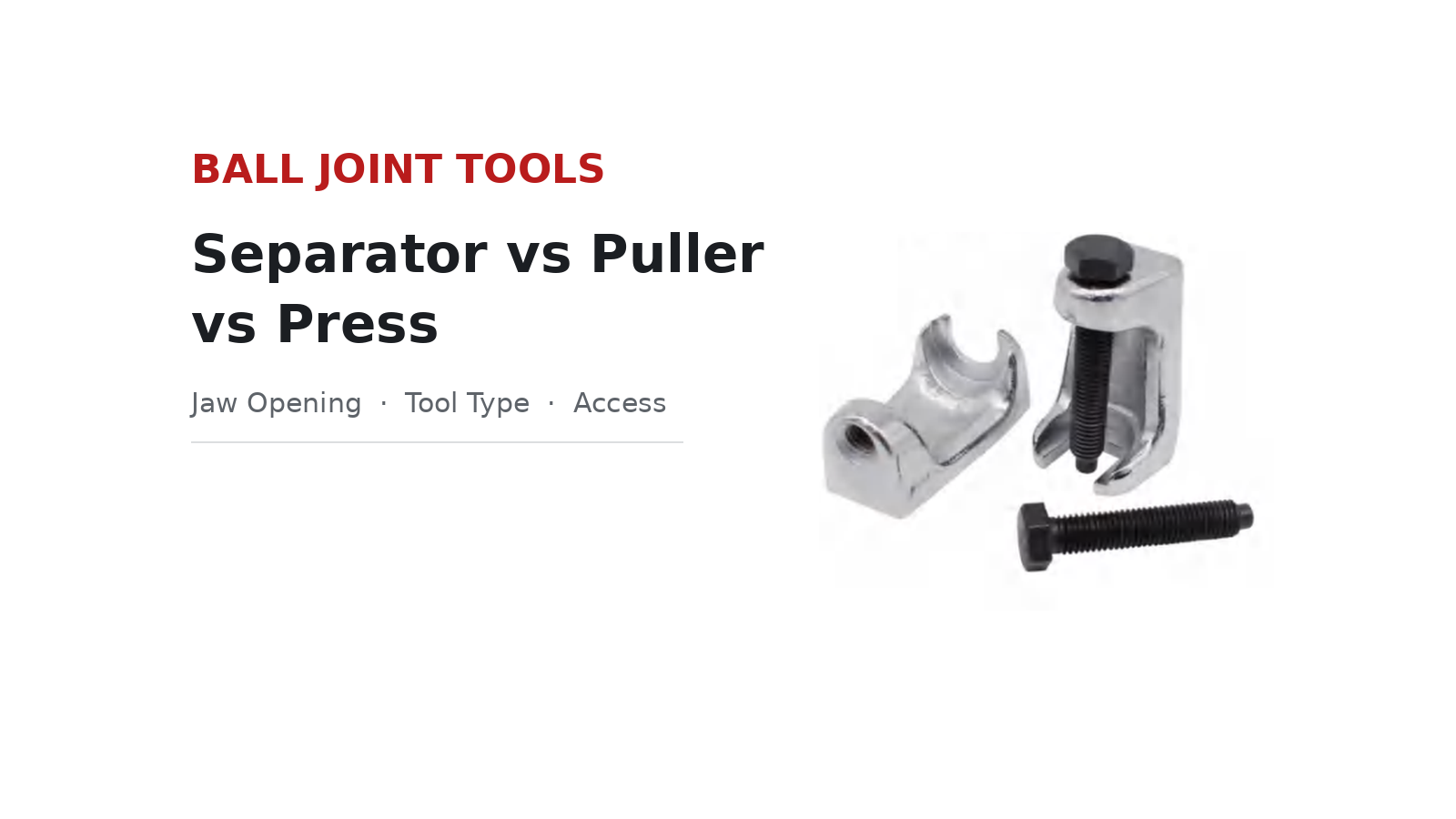
A separator or splitter is used on a tapered ball-joint stud: it pushes or wedges the stud out of its taper seat so the joint comes apart. Manufacturers describe these tools as separating the ball joint from the spindle support arm. Some are screw-driven, with a thrust bolt that pushes the stud out; others are fork-type, with a wedge driven between the parts.
The task is separation of a taper — it is not removal of a press-fit joint. A separator that suits a tapered stud is the wrong tool if the joint is pressed into a control arm or knuckle.
4. What a Puller Does
A puller draws a tapered arm off a shaft. Jaws grip the arm while a centre forcing screw is tightened to pull it free — the classic pitman-arm or tie-rod puller. Makers describe mounting the jaws over the arm, tightening the centre screw, and striking the screw to break the taper on stubborn joints.
A puller is a pull along the shaft, not a push inside a bore, and not a wedge between a stud and its seat. It is the same family of tapered-fit work as a separator, but a different action and a different tool.
5. What a Ball Joint Press Does
A ball joint press removes and installs press-fit joints. A C-frame holds receiver cups and adapters while a forcing screw drives the joint out of, or into, a bore or knuckle. Makers publish these kits for press-in ball joints, with adapter sets sized to the joint and housing.
This is the clearest boundary in the group: a press acts on a press-fit joint inside a bore, where the joint is held by interference, not by a taper. A press is not the tool for a tapered stud, and a separator is not the tool for pressing a joint out of a control arm.
6. Separator Geometry: Why Jaw Opening and Access Matter
Two dimensions decide whether a separator will physically engage. The jaw opening is the gap the tool straddles across the stud, and the jaw width is how wide that gap is — makers publish these separately, and both have to suit the joint. A slot that is too narrow will not pass over the stud; one that is too wide will not seat.
Access then decides whether the tool can reach the joint at all. Separation happens on the vehicle, often around a knuckle or arm, and makers sell long-reach variants for awkward or limited access. Confirming the opening and the access on the actual joint rules a tool in or out.
7. When a Fork-Type Separator Is Different from a Screw-Type Splitter
Fork-type and screw-type separators do the same job by different means. A screw-type splitter uses a thrust bolt turned against the stud to push it out, suiting joints where the tool can sit squarely. A fork-type separator is wedged between the parts and driven with a hammer, or fitted to an air hammer, suiting joints where striking access is available.
The two differ in how force is applied and in the access each needs. That is why one maker lists both a screw splitter and an impact fork, and why the choice follows the joint and the space around it.
8. Why Vehicle Name Alone Is Not Enough
The same vehicle line can use a tapered ball joint on one end and a press-fit joint on another, so a model name does not tell you which tool the job needs. Tool makers publish application guides precisely to flag where a joint is bolt-in or press-fit, and one maker notes that most modern cars use press-in joints.
Working from the vehicle name alone risks buying a separator for a press-fit joint, or a press for a tapered stud. The joint design, the opening it needs and the access decide the tool.
9. What Buyers Should Ask a Supplier to Document
The task the tool is built for — tapered-stud separation, pulling an arm, or pressing a joint in/out.
The jaw opening and, separately, the jaw width, where the tool is a separator.
Whether it is screw-type or fork/impact type.
The reach and any long-reach variant, against the access on the intended jobs.
What adapters or cups are included, where it is a press.
What is included in the set, and whether parts are available separately.
A description that offers only the name "ball joint tool" is not yet a specification. These fields let two tools be compared on one basis.
10. TEKO Confirmed Configuration
FJ06-013, the Car Truck Ball Joint Splitter, is a separator for separating ball joints on cars and trucks, as stated in the source specifications. It is documented with an 18 mm jaw opening, a size of 8×4.3 cm, a material of 40Cr and carbon steel, a hardness of HRV 38-40 and a weight of 435 g. It is packed as a box, QTY 20, G.W./N.W. 10/9 kg, and sits in the Suspension, Steering & Bearing Tools range.
The published material gives the jaw opening, size, material, hardness, weight and packing data, but does not list a jaw width, a reach figure or a vehicle application table. Send the joint type, the opening needed and the access condition so the configuration can be checked against them. For different packaging, labeling or branding, send the requirement with your inquiry so it can be reviewed case by case.
11. Frequently Asked Questions
Is a ball joint separator the same as a ball joint press?
No. A separator breaks a tapered stud out of its seat; a press pushes a press-fit joint in or out of a bore or knuckle. They are used on different joint designs.
When do I need a puller instead of a separator?
Use a puller to draw a tapered arm off a shaft, such as a pitman arm or tie rod. A separator breaks a tapered ball-joint stud free in place.
Why does jaw opening matter when choosing a separator?
The jaw opening is the gap the tool straddles across the stud, and the jaw width is how wide it is. Both have to suit the joint: too narrow will not pass over the stud, too wide will not seat.
What is the difference between a screw-type and a fork-type separator?
A screw-type turns a thrust bolt against the stud to push it out; a fork-type is wedged between the parts and struck with a hammer or air hammer. They need different access.
Why isn't the vehicle name enough to choose a ball joint tool?
The same model line can use a tapered joint in one place and a press-fit joint in another. Selection follows the joint design, the opening needed and the access, not the badge.
12. Request a Configuration Check
Send us the joint dimensions and tool requirements you need to cover, and we will confirm whether the available configuration fits your program.
---